Permanent Tooth Not Erupting After Milk Tooth Falls Out? Causes, Diagnosis and Treatment

What Is Delayed Permanent Tooth Eruption?
Delayed permanent tooth eruption occurs when a permanent tooth does not emerge within its expected developmental period.
Possible causes include insufficient space in the dental arch, ectopic positioning, impaction, physical obstruction, delayed dental development or congenital absence of the permanent tooth. A dentist evaluates the child's age, eruption sequence and clinical findings, using dental radiographs when indicated, to determine the appropriate management.
Why Hasn't My Child's Permanent Tooth Appeared?
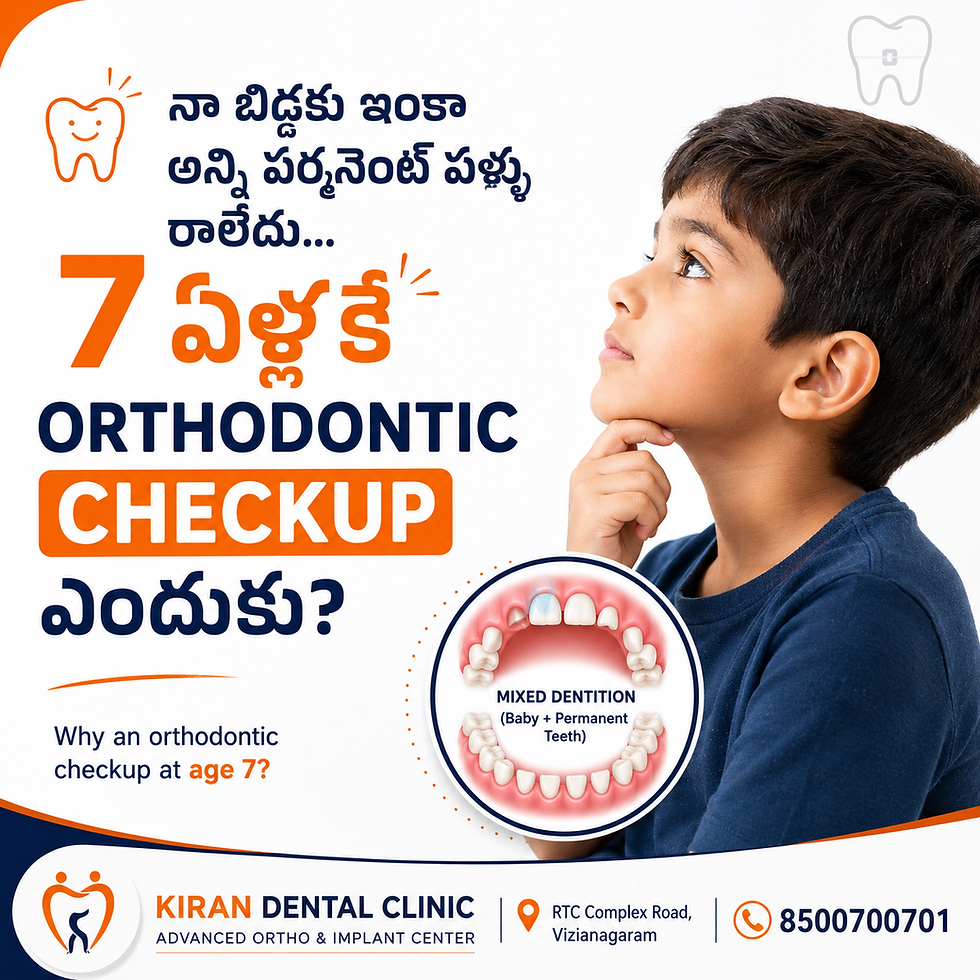
Children usually begin losing their milk teeth around six years of age. Permanent teeth gradually replace primary teeth during the mixed dentition period.
However, the permanent tooth may not become visible immediately after the baby tooth falls out.
The timing depends on several factors:
- Which milk tooth has fallen out.
- The child's age and dental development.
- The position and development of the permanent successor.
- Available space in the dental arch.
- Individual variations in tooth eruption.
For example, lower permanent central incisors generally erupt around 6–7 years, while upper permanent central incisors commonly erupt around 7–8 years.
These are typical eruption ranges, not strict deadlines.
What Causes Delayed Permanent Tooth Eruption?
Several conditions can interfere with the normal eruption pathway.
1. Insufficient Space in the Dental Arch
When there is inadequate space in the jaw or dental arch, a permanent tooth may have difficulty erupting into its correct position.
Crowding and premature loss of neighbouring primary teeth may contribute to space-related problems.
2. Impacted Permanent Tooth
An impacted tooth is a tooth that remains unerupted because its position or an obstruction interferes with normal eruption.
The tooth may be positioned at an unusual angle or may be unable to follow its normal eruption pathway.
3. Ectopic Eruption
Sometimes a permanent tooth develops in an abnormal position or direction.
This is called ectopic eruption. It may affect neighbouring teeth and can require orthodontic assessment.
4. Physical Obstruction
An additional tooth, known as a supernumerary tooth, or another obstruction may interfere with the eruption of a permanent tooth.
5. Delayed Dental Development or Congenital Absence
In some children, permanent teeth develop later than expected.
In other cases, a permanent successor may be congenitally absent, meaning that the tooth never developed.
These conditions cannot reliably be distinguished simply by looking at the empty space.
When Should Parents Consult a Dentist?
There is no single waiting period that applies to every permanent tooth.
Parents should consider a dental assessment when:
- One permanent tooth has not erupted while its corresponding tooth on the opposite side has already appeared.
- The gap remains empty for an unusually long period.
- There is visible crowding or insufficient space.
- A permanent tooth appears to be emerging in an unusual position.
- The child's tooth eruption sequence seems significantly different from expected developmental patterns.
- A primary tooth remains unusually long after the corresponding permanent tooth should normally have erupted.
A six-month difference between corresponding teeth can be a useful reason to investigate, but it is not a universal diagnostic rule.
How Is Delayed Tooth Eruption Diagnosed?
The first step is a clinical dental examination.
A dentist may assess:
- The child's age and dental history.
- Which primary tooth has exfoliated.
- The eruption of corresponding teeth.
- Available space in the dental arch.
- The position of neighbouring teeth.
- Any signs of obstruction or developmental abnormalities.
Is a Dental X-ray Necessary?
Not every child needs an X-ray.
When clinically indicated, an appropriate dental radiograph can help assess:
- Whether the permanent tooth is present.
- Its developmental stage.
- Its position within the jawbone.
- Its relationship with neighbouring teeth.
- Possible obstructions along its eruption pathway.
Depending on the clinical situation, a periapical, occlusal or panoramic radiograph may be considered.
Dental imaging in children should be individually justified following clinical examination, with radiation exposure minimised according to appropriate safety principles.
What Are the Treatment Options for Delayed Tooth Eruption?
Treatment depends on the cause, position of the tooth, developmental stage and available space.
Not every delayed tooth requires active treatment.
1. Observation and Monitoring
If the permanent tooth is developing normally and there are no concerning findings, periodic clinical monitoring may be sufficient.
2. Space Maintenance or Space Regaining
When premature loss of a primary tooth has resulted in changes in available space, an appropriate space-management approach may be considered.
3. Orthodontic Intervention
If crowding or an abnormal eruption pathway is affecting the permanent tooth, orthodontic treatment may be planned.
4. Management of Impacted Teeth
Depending on the position and developmental stage, treatment may involve monitoring, removal of an obstruction or surgical exposure with orthodontic assistance.
5. Management of Congenitally Missing Teeth
If the permanent successor is absent, long-term planning may involve maintaining the available space, orthodontic space management or restorative options at an appropriate stage.
The treatment plan should always be individualised.
Can Delayed Tooth Eruption Be Prevented?
Not every cause of delayed eruption can be prevented. However, regular dental assessments during childhood can help identify developmental problems early.
Parents can support healthy dental development by:
- Maintaining regular dental checkups.
- Treating decay in primary teeth promptly.
- Avoiding premature extraction of milk teeth without appropriate planning.
- Following the dentist's advice regarding space maintenance.
- Monitoring changes in tooth eruption.
- Seeking assessment when eruption patterns appear unusual.
Primary teeth are important for chewing, speech development and maintaining space for permanent successors.
Myths vs Facts About Permanent Tooth Eruption
Myth 1: A permanent tooth must appear immediately after a milk tooth falls out.
Fact: Some variation in eruption timing is normal. The permanent successor may take time to become visible.
Myth 2: Every missing permanent tooth is impacted.
Fact: Delayed development and congenital absence are also possible explanations.
Myth 3: All children need an X-ray when a tooth is delayed.
Fact: Radiographs are selected according to clinical findings and diagnostic requirements.
Myth 4: Waiting is always the best option.
Fact: Some eruption problems benefit from timely diagnosis and intervention.
Myth 5: Milk teeth do not matter once permanent teeth begin developing.
Fact: Primary teeth help maintain function and space for permanent successors.
Frequently Asked Questions
1. How long does it take for a permanent tooth to come after a milk tooth falls out?
There is no fixed interval. It varies depending on the tooth, the child's age and developmental stage. A dentist can assess whether the timing is appropriate.
2. What if my child's permanent front tooth has not appeared for six months?
A dental examination is reasonable, particularly if the corresponding tooth on the opposite side has erupted. An X-ray may be recommended depending on the clinical findings.
3. Can a permanent tooth remain inside the jawbone?
Yes. An unerupted or impacted permanent tooth may remain within the jawbone. Radiographic evaluation can help identify its position.
4. What happens if the permanent tooth is missing?
If the permanent successor is congenitally absent, the dentist can discuss monitoring and long-term space-management options.
5. Does every delayed permanent tooth need surgery?
No. Some cases only need observation, while others may require orthodontic or surgical management. Treatment depends on the diagnosis.
6. Should I visit an orthodontist for delayed tooth eruption?
An orthodontic assessment may be helpful when crowding, insufficient space, ectopic eruption or impaction is suspected.
Conclusion: Don't Ignore Unusual Changes in Your Child's Tooth Eruption
A permanent tooth that does not appear after a milk tooth falls out is not automatically a cause for alarm. However, unexplained or significant delays should not be ignored.
Early assessment can help identify whether the tooth is developing normally, whether sufficient space is available and whether any intervention is necessary.
Understanding the cause is the first step towards appropriate dental care.
Dental Evaluation in Vizianagaram
At Kiran Dental Clinic – Advanced Ortho & Implant Center, Vizianagaram, we emphasise accurate diagnosis, appropriate investigations and individualised treatment planning.
Our doctors:
Dr. Kiran Vungarala, MDS – Orthodontist
Dr. Priyanka Majji, MDS – Periodontist & Implantologist
If you have concerns about your child's permanent tooth eruption or dental development, consult a dentist for an individual assessment.
Contact Kiran Dental Clinic
Phone: 8500700701
Website: https://kirandentalvzm.com
Location: Vizianagaram, Andhra Pradesh.
Educational information only. A clinical examination is necessary to determine the cause and appropriate management for an individual child.
References and Further Reading
1. American Academy of Pediatric Dentistry (AAPD) – Management of the Developing Dentition and Occlusion in Pediatric Dentistry.
2. American Academy of Pediatric Dentistry – Prescribing Dental Radiographs for Infants, Children, Adolescents and Individuals with Special Health Care Needs.
3. American Dental Association (ADA) – Dental Radiographic Examinations.
4. US Food and Drug Administration (FDA) – Dental Radiographic Examinations: Recommendations for Patient Selection and Limiting Radiation Exposure.

Comments